Showing posts with label History. Show all posts

Wednesday, 18 February 2015

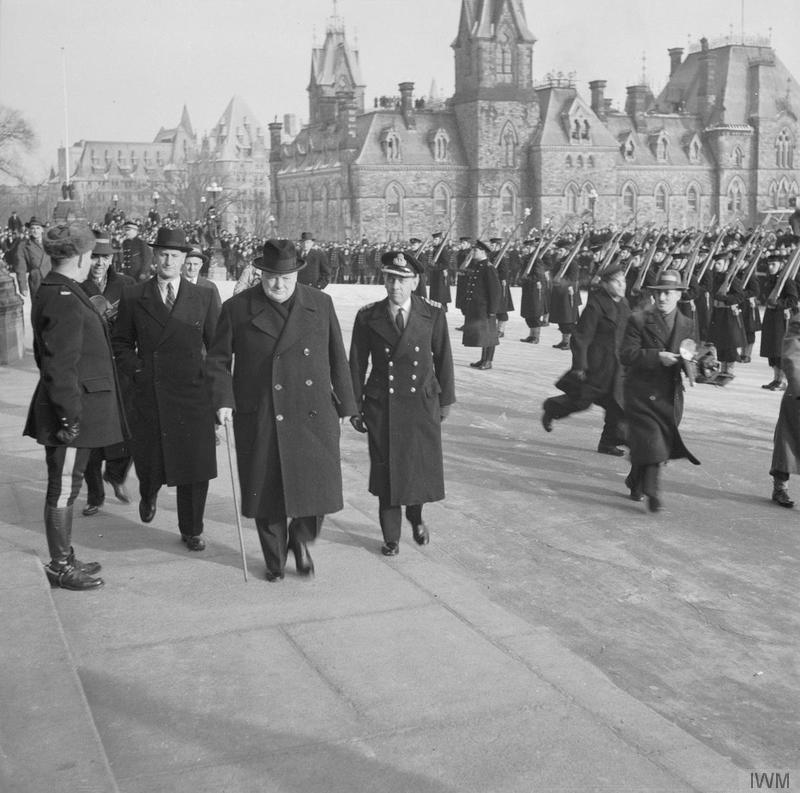
Winston Churchill arrives outside the Canadian Houses of Parliament in Ottawa, Canada, 1941


Embedded image permalink


Sir Winston Leonard Spencer-Churchill, KG, OM, CH, TD, DL, FRS, RA (30 November 1874 – 24 January 1965) was a British politician who was the Prime Minister of the United Kingdom from 1940 to 1945 and again from 1951 to 1955. Widely regarded as one of the greatest wartime leaders of the 20th century, Churchill was also an officer in the British Army, a historian, a writer (as Winston S. Churchill), and an artist. He won the Nobel Prize in Literature, and was the first person to be made an honorary citizen of the United States.
Churchill was born into the aristocratic family of the Dukes of Marlborough, a branch of the Spencer family. His father, Lord Randolph Churchill, was a charismatic politician who served as Chancellor of the Exchequer; his mother, Jennie Jerome, was an American socialite. As a young army officer, he saw action in British India, the Sudan, and the Second Boer War. He gained fame as a war correspondent and wrote books about his campaigns.
At the forefront of politics for fifty years, he held many political and cabinet positions. Before the First World War, he served as President of the Board of Trade, Home Secretary, and First Lord of the Admiralty as part of Asquith's Liberal government. During the war, he continued as First Lord of the Admiralty until the disastrous Gallipoli Campaign caused his departure from government. He then briefly resumed active army service on the Western Front as commander of the 6th Battalion of the Royal Scots Fusiliers. He returned to government as Minister of Munitions, Secretary of State for War, and Secretary of State for Air. In 1921–1922 Churchill served as Secretary of State for the Colonies, then Chancellor of the Exchequer in Baldwin's Conservative government of 1924–1929, 


controversially returning the pound sterling in 1925 to the gold standard at its pre-war parity, a move widely seen as creating deflationary pressure on the UK economy. Also controversial were his opposition to increased home rule for India and his resistance to the 1936 abdication of Edward VIII.
Out of office and politically "in the wilderness" during the 1930s, Churchill took the lead in warning about Nazi Germany and in campaigning for rearmament. At the outbreak of the Second World War, he was again appointed First Lord of the Admiralty. Following the resignation of Neville Chamberlain on 10 May 1940, Churchill became Prime Minister. His steadfast refusal to consider surrender helped inspire British resistance, especially during the difficult early days of the war when the British Commonwealth and Empire stood alone in its active opposition to Adolf Hitler. Churchill was particularly noted for his speeches and radio broadcasts, which helped inspire the British people. He led Britain as Prime Minister until victory over Nazi Germany had been secured.
After the Conservative Party lost the 1945 election, he became Leader of the Opposition to the Labour Government. After winning the 1951 election, he again became Prime Minister, before retiring in 1955. Upon his death, Elizabeth II granted him the honour of a state funeral, which saw one of the largest assemblies of world statesmen in history. Named the Greatest Briton of all time in a 2002 poll, Churchill is widely regarded as being among the most influential people in British history, consistently ranking well in opinion polls of Prime Ministers of the United Kingdom.

Tuesday, 13 January 2015

Execution of rebels during the German occupation of Poland in WWII

Embedded image permalink

History of Oscar Wilde , A Distinguish Writer And a Poet


Oscar Fingal O'Flahertie Wills Wilde (16 October 1854 – 30 November 1900) was an Irish writer and poet. After writing in different forms throughout the 1880s, he became one of London's most popular playwrights in the early 1890s. Today he is remembered for his epigrams, his novel The Picture of Dorian Gray, his plays, as well as the circumstances of his imprisonment and early death.

Oscar Wilde Sarony.jpg
Wilde's parents were successful Anglo-Irish Dublin intellectuals. Their son became fluent in French and German early in life. At university, Wilde read Greats; he proved himself to be an outstanding classicist, first at Dublin, then at Oxford. He became known for his involvement in the rising philosophy of aestheticism, led by two of his tutors, Walter Pater and John Ruskin. After university, Wilde moved to London into fashionable cultural and social circles. As a spokesman for aestheticism, he tried his hand at various literary activities: he published a book of poems, lectured in the United States and Canada on the new "English Renaissance in Art", and then returned to London where he worked prolifically as a journalist. Known for his biting wit, flamboyant dress and glittering conversation, Wilde became one of the best-known personalities of his day.
At the turn of the 1890s, he refined his ideas about the supremacy of art in a series of dialogues and essays, and incorporated themes of decadence, duplicity, and beauty into his only novel, The Picture of Dorian Gray (1890). The opportunity to construct aesthetic details precisely, and combine them with larger social themes, drew Wilde to write drama. He wrote Salome (1891) in French in Paris but it was refused a licence for England due to the absolute prohibition of Biblical subjects on the English stage. Unperturbed, Wilde produced four society comedies in the early 1890s, which made him one of the most successful playwrights of late Victorian London.
At the height of his fame and success, while his masterpiece, The Importance of Being Earnest (1895), was still on stage in London, Wilde had the Marquess of Queensberry prosecuted for libel. The Marquess was the father of Wilde's lover, Lord Alfred Douglas. The charge carried a penalty of up to two years in prison. The trial unearthed evidence that caused Wilde to drop his charges and led to his own arrest and trial for gross indecency with other men. After two more trials he was convicted and imprisoned for two years' hard labour. In 1897, in prison, he wrote De Profundis, which was published in 1905, a long letter which discusses his spiritual journey through his trials, forming a dark counterpoint to his earlier philosophy of pleasure. Upon his release he left immediately for France, never to return to Ireland or Britain. There he wrote his last work, The Ballad of Reading Gaol (1898), a long poem commemorating the harsh rhythms of prison life. He died destitute in Paris at the age of 46.

 Early life

 
Wilde Family home on Merrion Square

 
Statue of Oscar Wilde in Merrion Square, Dublin. The materials are granite, green nephrite jade, whitejadeite and thulite.
Oscar Wilde was born at 21 Westland Row, Dublin (now home of the Oscar Wilde Centre, Trinity College), the second of three children born to Sir William Wilde and Jane Wilde, two years behind William ("Willie"). Wilde's mother, under the pseudonym "Speranza" (the Italian word for 'Hope'), wrote poetry for the revolutionary Young Irelanders in 1848 and was a lifelong Irish nationalist. She read the Young Irelanders' poetry to Oscar and Willie, inculcating a love of these poets in her sons. Lady Wilde's interest in the neo-classical revival showed in the paintings and busts of ancient Greece and Rome in her home. William Wilde was Ireland's leading oto-ophthalmologic (ear and eye) surgeon and was knighted in 1864 for his services as medical adviser and assistant commissioner to the censuses of Ireland.[4] He also wrote books about Irish archaeology and peasant folklore. A renowned philanthropist, his dispensary for the care of the city's poor at the rear of Trinity College, Dublin, was the forerunner of the Dublin Eye and Ear Hospital, now located at Adelaide Road. On his father's side Wilde was descended from a Dutchman, Colonel de Wilde, who went to Ireland with King William of Orange's invading army in 1690. On his mother's side Wilde's ancestors included a bricklayer from County Durham who emigrated to Ireland sometime in the 1770s.
Wilde was baptised as an infant in St. Mark's Church, Dublin, the local Church of Ireland (Anglican) church. When the church was closed, the records were moved to the nearby St. Ann's Church, Dawson Street.
In addition to his children with his wife, Sir William Wilde was the father of three children born out of wedlock before his marriage: Henry Wilson, born in 1838, and Emily and Mary Wilde, born in 1847 and 1849, respectively, of different maternity to Henry. Sir William acknowledged paternity of his illegitimate children and provided for their education, but they were reared by his relatives rather than with his wife and legitimate children.
In 1855, the family moved to No. 1 Merrion Square, where Wilde's sister, Isola, was born in 1857. The Wildes' new home was larger and, with both his parents' sociality and success, it soon became a "unique medical and cultural milieu". Guests at their salon included Sheridan Le Fanu, Charles Lever, George Petrie, Isaac Butt, William Rowan Hamilton and Samuel Ferguson.
Until he was nine, Oscar Wilde was educated at home, where a French bonne and a German governess taught him their languages. He then attended Portora Royal School in Enniskillen, County Fermanagh. Until his early twenties, Wilde summered at the villa, Moytura House, his father built in Cong, County Mayo. There the young Wilde and his brother Willie played with George Moore.
Isola died aged nine of meningitis. Wilde's poem "Requiescat" is dedicated to her memory:
"Tread lightly, she is near
Under the snow
Speak gently, she can hear
the daisies grow"

Sunday, 11 January 2015

Monday, 5 January 2015

Police Struggling To Restrain Beatles Fans Outside Buckingham Palace In October, 1965


History of Baseball


Baseballpositions.png
Baseball is a bat-and-ball game played between two teams of nine players each who take turns batting and fielding.
The offense attempts to score runs by hitting a ball thrown by the pitcher with a bat and moving counter-clockwise around a series of four bases: first, second, third, and home plate. A run is scored when a player advances around the bases and returns to home plate.
Players on the batting team take turns hitting against the pitcher of the fielding team, which tries to prevent runs by getting hitters out in any of several ways. A player on the batting team who reaches a base safely can later attempt to advance to subsequent bases during teammates' turns batting, such as on a hit or by other means. The teams switch between batting and fielding whenever the fielding team records three outs. One turn batting for both teams, beginning with the visiting team, constitutes an inning. A game comprises nine innings, and the team with the greater number of runs at the end of the game wins.
Evolving from older bat-and-ball games, an early form of baseball was being played in England by the mid-18th century. This game was brought by immigrants to North America, where the modern version developed. By the late 19th century, baseball was widely recognized as the national sport of the United States. Baseball is now popular in North America and parts of Central and South America and the Caribbean, East Asia, and Europe.
In the United States and Canada, professional Major League Baseball (MLB) teams are divided into the National League (NL) and American League (AL), each with three divisions: East, West, and Central. The major league champion is determined by playoffs that culminate in the World Series. The top level of play is similarly split in Japan between the Central League and Pacific Leagues and in Cuba between the West League and East League.

The evolution of baseball from older bat-and-ball games is difficult to trace with precision. A French manuscript from 1344 contains an illustration of clerics playing a game, possibly la soule, with similarities to baseball. Other old French games such as thèque, la balle au bâton, and la balle empoisonnée also appear to be related. Consensus once held that today's baseball is a North American development from the older game rounders, popular in Great Britain and Ireland. Baseball Before We Knew It: A Search for the Roots of the Game (2005), by David Block, suggests that the game originated in England; recently uncovered historical evidence supports this position. Block argues that rounders and early baseball were actually regional variants of each other, and that the game's most direct antecedents are the English games of stoolball and "tut-ball". It has long been believed that cricket also descended from such games, though evidence uncovered in early 2009 suggests that cricket may have been imported to England from Flanders.
The earliest known reference to baseball is in a 1744 British publication, A Little Pretty Pocket-Book, by John Newbery. It contains a rhymed description of "base-ball" and a woodcut that shows a field set-up somewhat similar to the modern game—though in a triangular rather than diamond configuration, and with posts instead of ground-level bases. David Block discovered that the first recorded game of "Bass-Ball" took place in 1749 in Surrey, and featured the Prince of Wales as a player. William Bray, an English lawyer, recorded a game of baseball on Easter Monday 1755 in Guildford, Surrey. This early form of the game was apparently brought to North America by English immigrants. Rounders was also brought to the continent by both British and Irish immigrants. The first known American reference to baseball appears in a 1791 Pittsfield, Massachusetts, town bylaw prohibiting the playing of the game near the town's new meeting house. By 1796, a version of the game was well-known enough to earn a mention in a German scholar's book on popular pastimes. As described by Johann Gutsmuths, "englische Base-ball" involved a contest between two teams, in which "the batter has three attempts to hit the ball while at the home plate." Only one out was required to retire a side.

 
Alexander Cartwright, father of modern baseball
By the early 1830s, there were reports of a variety of uncodified bat-and-ball games recognizable as early forms of baseball being played around North America. These games were often referred to locally as "town ball", though other names such as "round-ball" and "base-ball" were also used. Among the earliest examples to receive a detailed description—albeit five decades after the fact, in a letter from an attendee to Sporting Life magazine—took place in Beachville, Ontario, in 1838. There were many similarities to modern baseball, and some crucial differences: five bases (or byes); first bye just 18 feet (5.5 m) from the home bye; batter out if a hit ball was caught after the first bounce. The once widely accepted story that Abner Doubleday invented baseball in Cooperstown, New York, in 1839 has been conclusively debunked by sports historians.
In 1845, Alexander Cartwright, a member of New York City's Knickerbocker Club, led the codification of the so-called Knickerbocker Rules. The practice, common to bat-and-ball games of the day, of "soaking" or "plugging"—effecting a putout by hitting a runner with a thrown ball—was barred. The rules thus facilitated the use of a smaller, harder ball than had been common. Several other rules also brought the Knickerbockers' game close to the modern one, though a ball caught on the first bounce was, again, an out and only underhand pitching was allowed. While there are reports that the New York Knickerbockers played games in 1845, the contest now recognized as the first officially recorded baseball game in U.S. history took place on June 19, 1846, in Hoboken, New Jersey: the "New York Nine" defeated the Knickerbockers, 23–1, in four innings. With the Knickerbocker code as the basis, the rules of modern baseball continued to evolve over the next half-century.